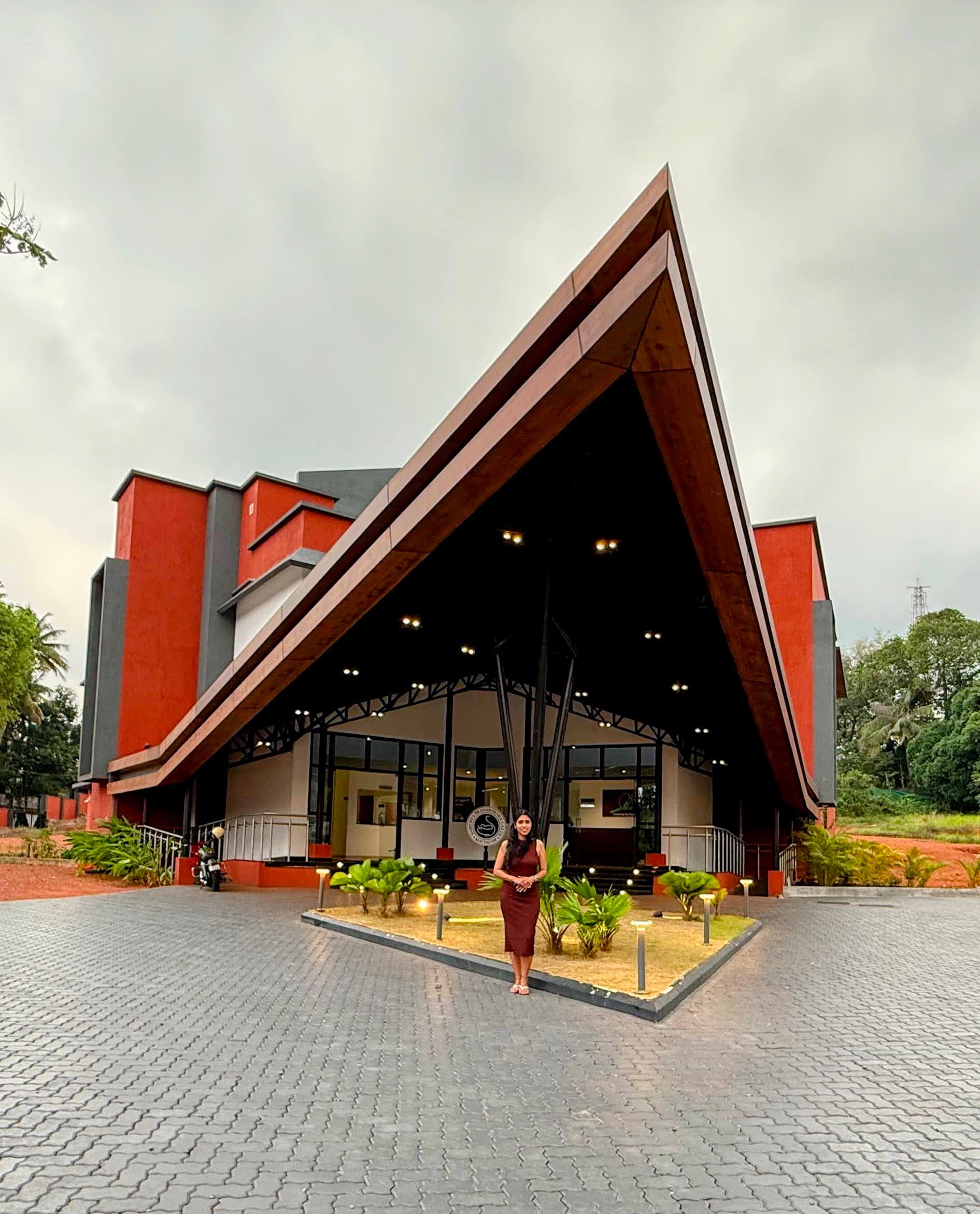
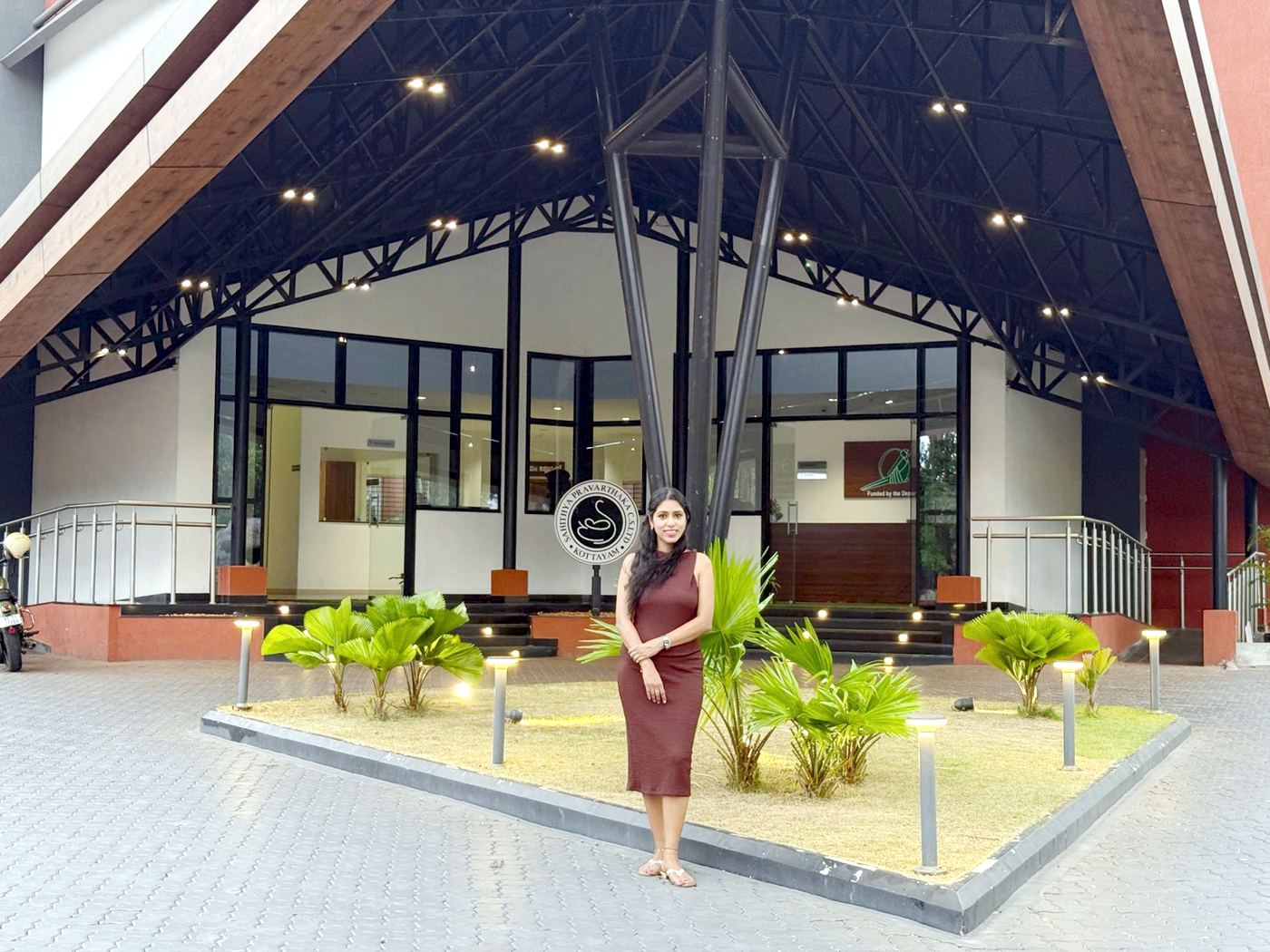
Recently, on our way to Lulu Mall in Kottayam, my husband and I noticed a structure that caught our eye. Against the region’s traditional landscape, a triangular building stood out, looking straight out of an architectural magazine. Intrigued, I checked Google Maps and discovered it was the Aksharam Museum of Letters, Literature and Culture, India’s first Museum of Malayalam Language and Literature.
I realized I had to return another day to explore the museum.
A few weeks later, we visited the museum in the evening, an hour before closing. As a first-time visitor, I didn’t know what to expect. Is the museum just a pretty-looking building, dusty and boring inside? Does it have an old collection of manuscripts and nothing more? Boy, was I surprised! The Aksharam Museum, a language museum in Kerala, turned out to be one of the most modern museums I have visited, offering glimpses of how humanity found its voice and world-class interactive experiences that stay with you even after you leave!
5 Interesting Facts About the Aksharam Museum, Kottayam
- Inaugurated in Nov 2024, the Aksharam Museum is India’s first museum dedicated exclusively to language, scripts, literature, and culture.
- It showcases early forms of human communication through cave art and symbols, as well as the evolution of the Malayalam language and literature.
- The museum is designed like an actual timeline you walk through (from cave symbols and primitive origins of expression to early scripts to literature), and is more about experiencing and storytelling than just viewing.
- The museum is located in Kottayam, historically known as ‘Akshara Nagari,’ or the City of Letters, and the first district in India to achieve full literacy. To date, Kottayam is known for its rich legacy in education, printing, and publishing.
-
While most other museums feature physical artifacts, this is one of Kerala’s unique cultural attractions, with many more digital and interactive displays and audio-visual storytelling offering a truly immersive experience.
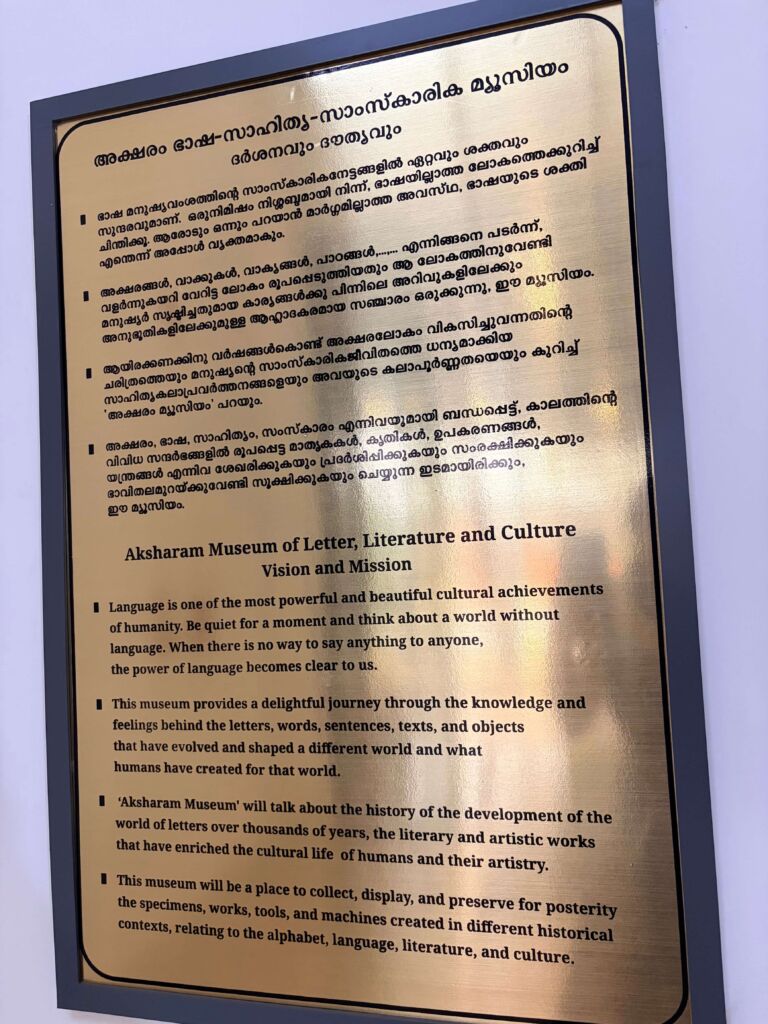
This panel outlines the vision of the Aksharam Museum, emphasizing language as a key cultural achievement. It highlights the museum’s aim to showcase the evolution of letters, literature, and communication tools. The display also focuses on preserving historical artifacts and promoting understanding of how language shapes human expression and culture.
Aksharam Museum, Kottayam: My Review, First Impressions & Outdoor Displays
At this innovative museum in Nattakom, Kerala (Kottayam), architecture meets history, and the connection with the museum begins even before you buy a ticket. The structure itself makes a bold statement, showcasing contemporary design and superior conceptualization. The approach to the main building is well-maintained, with plenty of greenery and ample parking, setting the tone for what’s to come.
Parking done, we headed toward the museum entrance and were intrigued to see three outdoor displays to the right. We knew the museum experience had already started!
Three notable structures stood here –
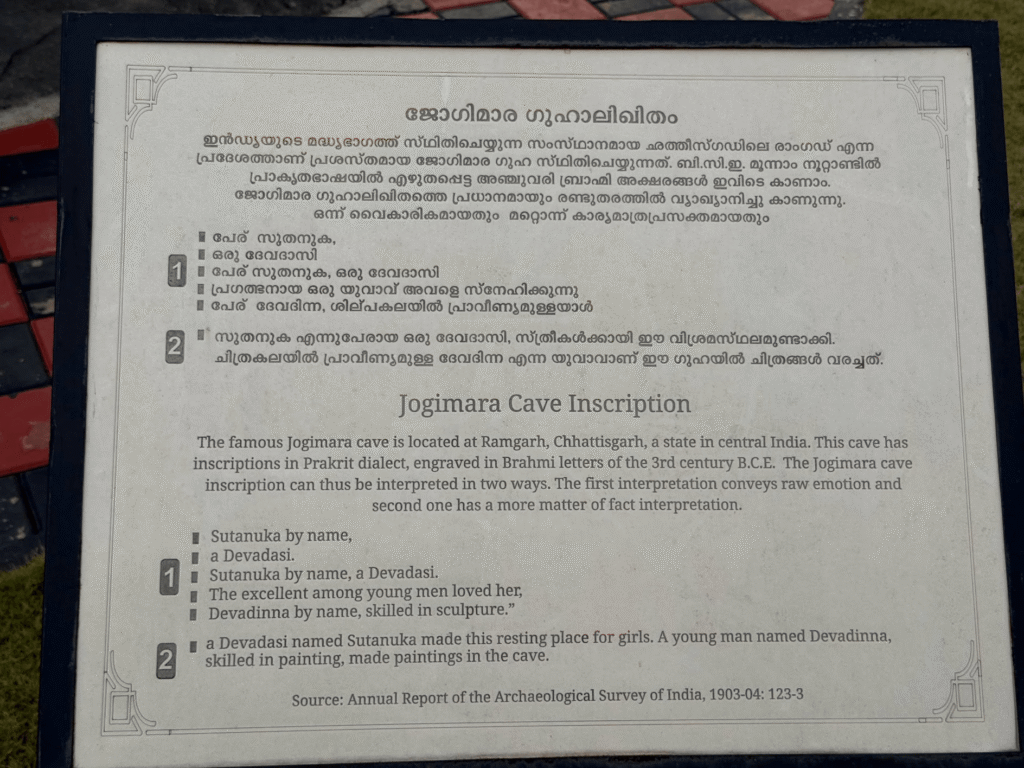
1. The Jogimara Cave Inscriptions in Ramgarh, Chhattisgarh:
Dating back to the 3rd century BCE, and inscribed in Brahmi script, these Prakrit inscriptions are often described by some scholars as one of the earliest inscriptions expressing personal emotion or affection in India.
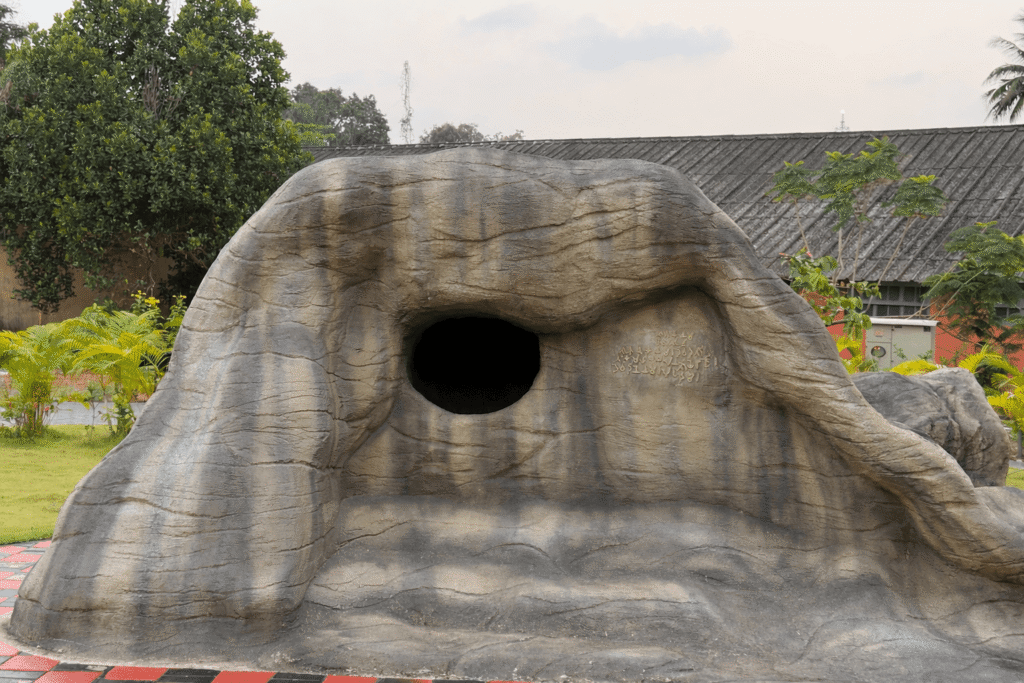
What do the Jogimara Cave Inscriptions say? Scholars believe the inscription refers to a poetic love declaration between Sutanuka, a devadasi, and Devadinna, a sculptor. Another view is that the names are a record of the individuals linked to the cave.
Either way, this shows that early Indian writing was not limited to administrative tasks but also laid the foundation for human connection and emotions.
2. Egyptian Scribe Sculpture with Papyrus
This outdoor installation depicts an ancient Egyptian scribe seated, reading a partially unrolled papyrus scroll. It signifies the literacy practices from roughly the 14th century BCE and emphasizes the importance of scribes in safeguarding knowledge, religion, and administration in ancient Egypt.
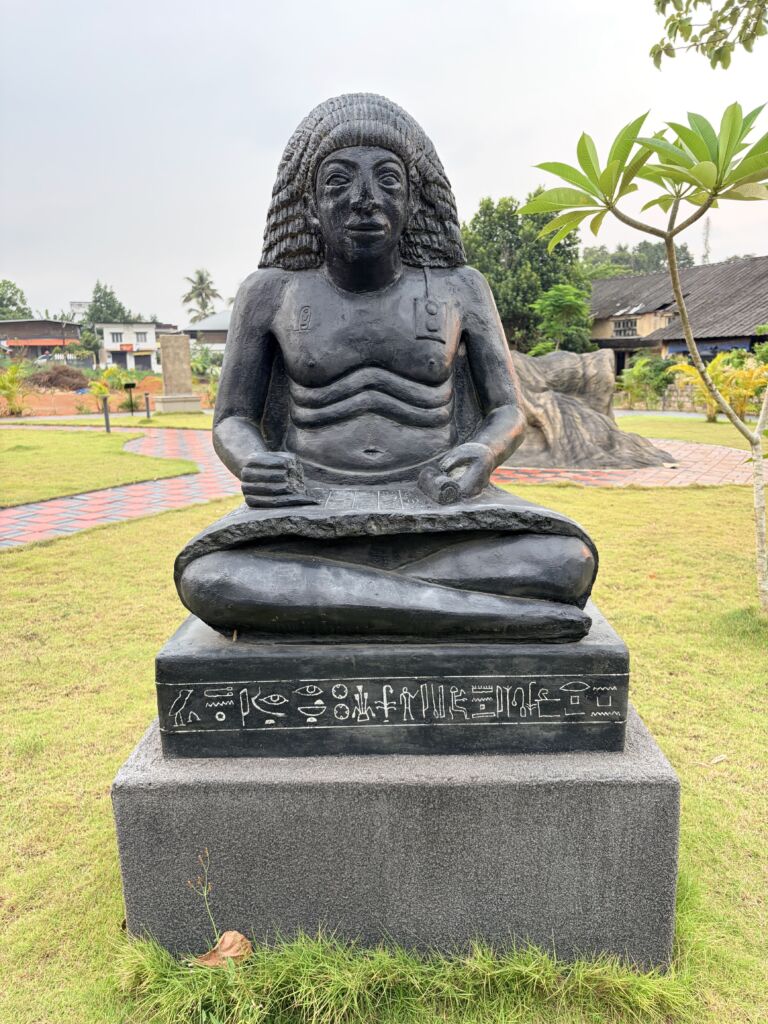
Another highlight is the hieroglyphic carvings on the base of the figure, further showcasing early writing systems. It is interesting to note how the different ancient civilizations created systems for recording culture, language, and ideas.
3. Thoth and Egyptian Writing Tradition Display
This installation features representations linked to Thoth, the Egyptian God of Writing (in the form of a monkey), often depicted in animal form and associated with wisdom, language, and record-keeping.
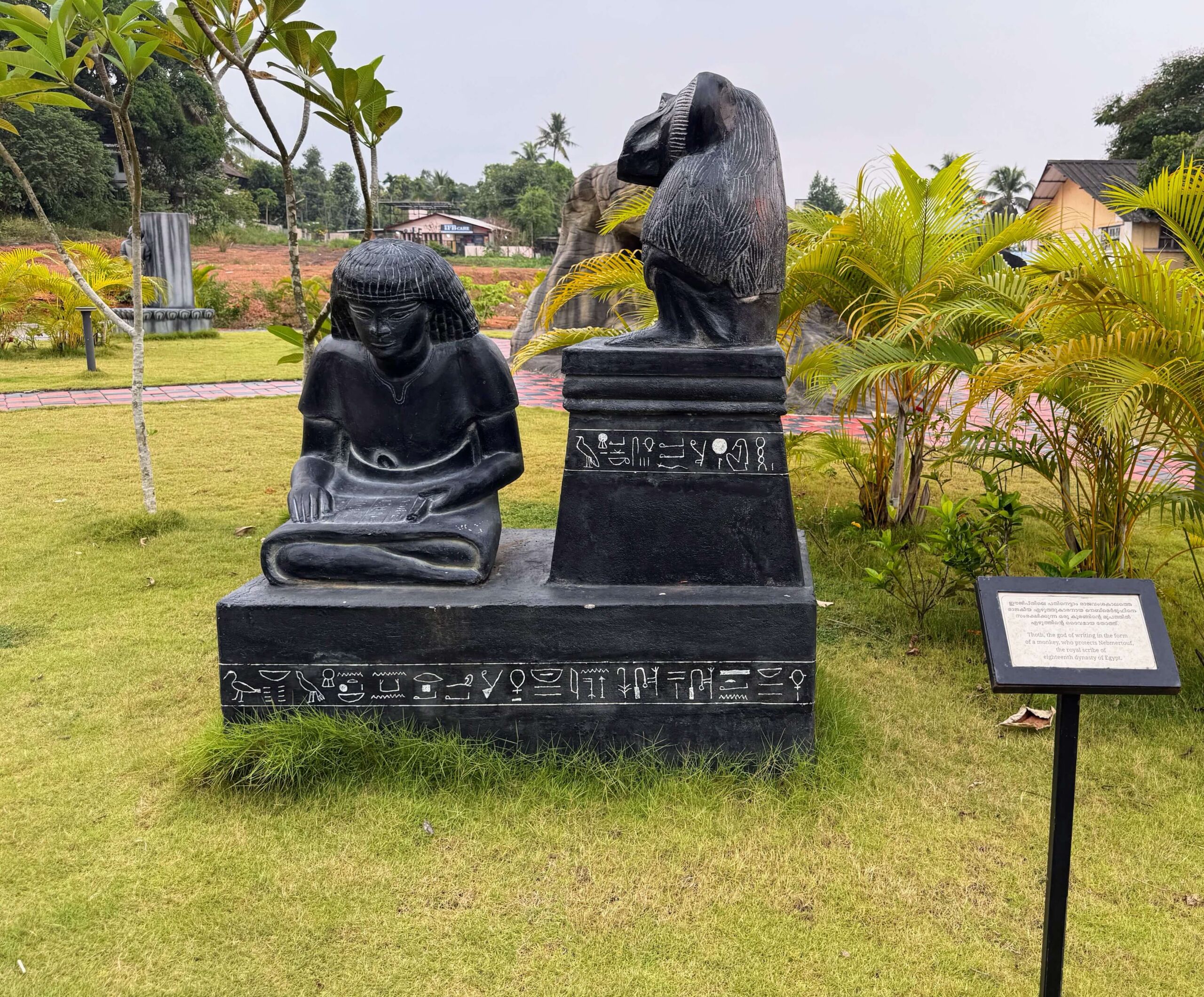
As the plaque indicates, Thoth is believed to have safeguarded royal scribes such as Nebmerteuf from Egypt’s Eighteenth Dynasty. The nearby seated scribe statue emphasizes the ancient Egyptian belief that knowledge and writing are interconnected. Collectively, the sculptures and inscriptions demonstrate that writing held a sacred significance beyond its practical use.
This exhibit at the Aksharam Museum Kottayam emphasizes the link between mythology and literacy, illustrating how cultures valued the act of recording knowledge.
Other Notable Displays at the Aksharam Museum
Though the number of exhibits at the museum is huge and outside the scope of this article, here are some of the exhibits and displays that stood out to me:
1. Audio-Visual Presentation Depicting the Evolution of Early Humans
After purchasing your tickets, you will enter the first hall and find yourself in an enchanting, immersive corridor with surround-sound and large-scale wall illustrations depicting the different stages of early human evolution. The figures resemble prehistoric hominins, a common exhibit in museums that depicts the transition from early human ancestors to more advanced forms, inspired by fossil evidence and anthropological research.
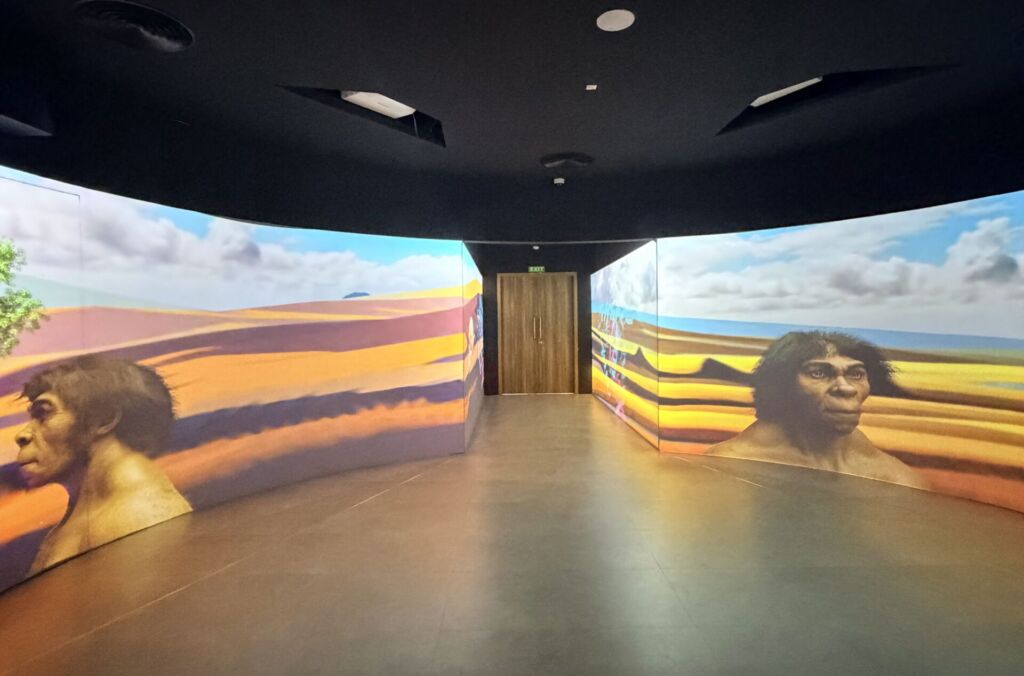
This became my favorite exhibit because it helps visitors connect with the fascinating journey of how our cognitive skills, such as communication and symbolic thinking, have evolved over time. It also tells the story of language and expressive abilities that developed step by step alongside human evolution, ultimately leading to the creation of structured systems such as symbols, scripts, and written language.
2. Prehistoric Rock Art Panels (Lascaux, Altamira, Chauvet)
The prehistoric rock art panels at the Aksharam Museum are replicas of prehistoric cave paintings inspired by sites such as Lascaux (France), Altamira (Spain), and Chauvet Cave (France). They date back to the Paleolithic period (approximately 30,000–15,000 BCE), and depict animals such as horses, bison, and deer.
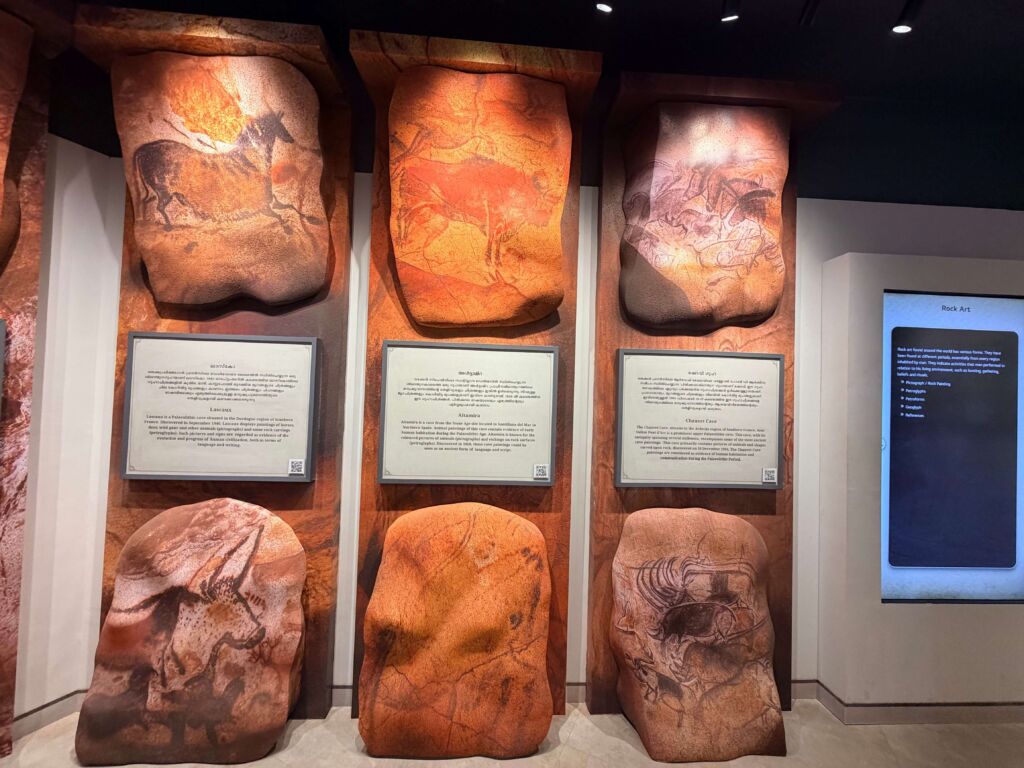
Created with natural pigments such as ochre and charcoal, these paintings are amongst the earliest known forms of visual communication and early evidence of human creativity, often linked to ritual, storytelling, or communication in prehistoric societies.
3. Pictograph / Rock Painting Explanation Panel
This display explains how pictographs are among the earliest forms of communication, using images to represent ideas, objects, or actions. Unlike written scripts, they rely on recognizable visuals rather than phonetic sounds. Found mainly in caves and rock shelters, they date back to the Stone Age and were used across many ancient cultures.
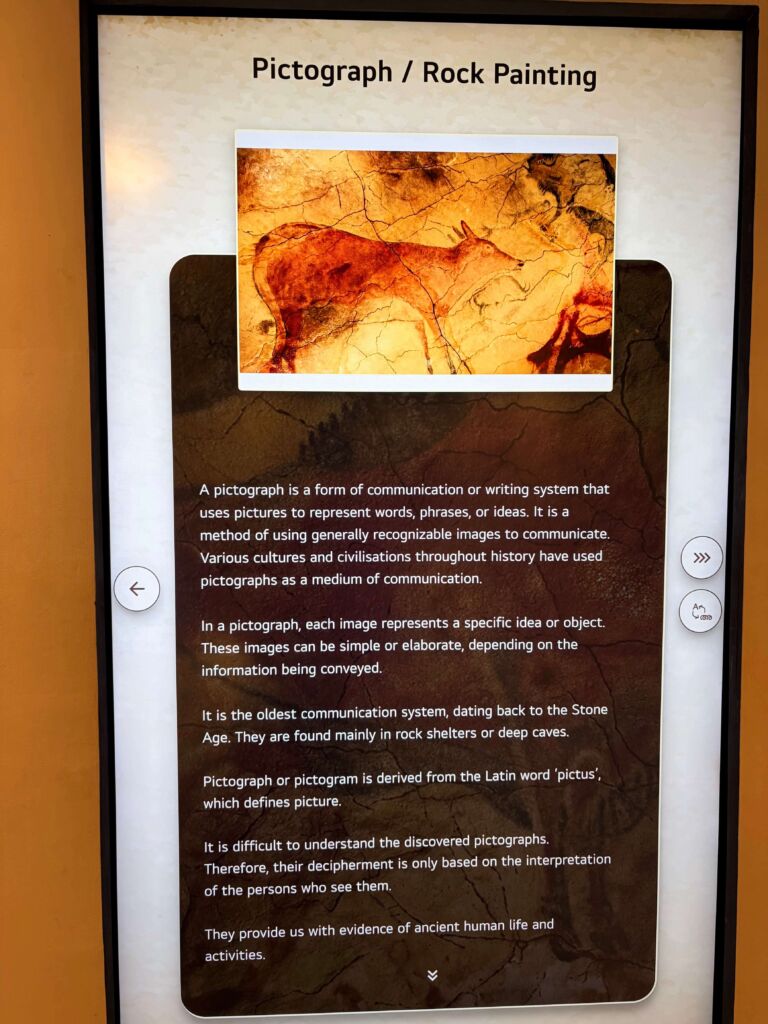
The panel emphasizes that interpreting pictographs can often feel subjective since their meanings are inferred rather than directly translated. Nevertheless, pictographs offer valuable insights into early human life, activities, and environments. This makes them a meaningful step in the journey from simple visual representations to more structured writing systems.
4. Hieroglyphics and Rosetta Stone Panel
The museum features a display inspired by the Hieroglyphics and Rosetta Stone Panel display. It explains Egyptian hieroglyphics, a logographic writing system in which symbols represent sounds, objects, or ideas. These inscriptions were commonly carved on temple walls and later written on materials such as papyrus and stone tablets.
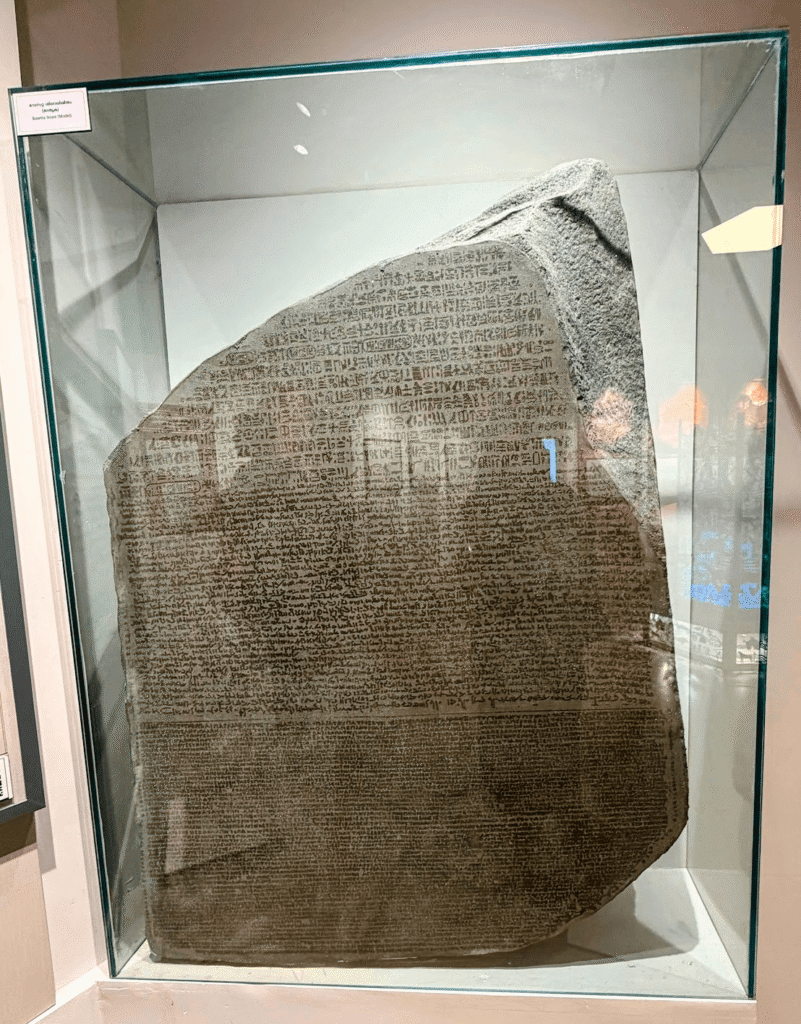
The panel emphasizes the significance of the Rosetta Stone, which allowed scholars to decode hieroglyphics. The stone bears the same inscription in three scripts—hieroglyphics, Demotic, and Greek, and dates back to 196 BCE, during Ptolemy V’s rule. Its discovery was vital for understanding ancient Egyptian language and inscriptions.
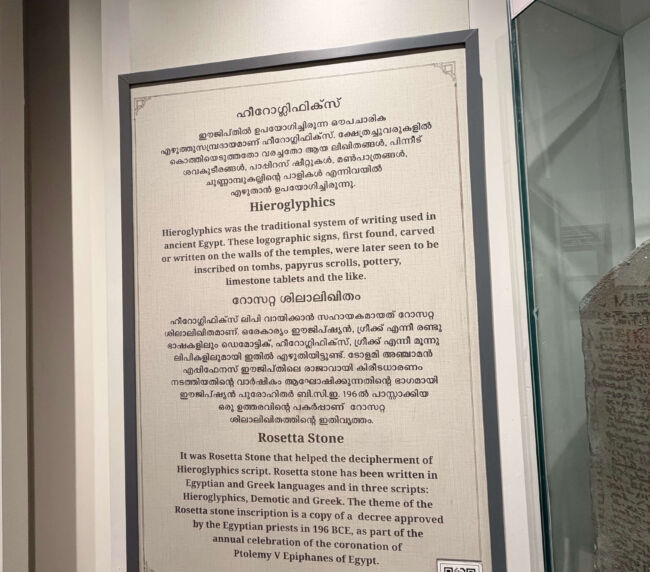
5. Dholavira Signboard (Indus Valley Civilization)
This exhibit features a model of the Dholavira signboard, associated with the Indus Valley Civilization (circa 2600–1900 BCE). The symbols are from the still-undeciphered Indus script, one of the earliest writing systems in South Asia.
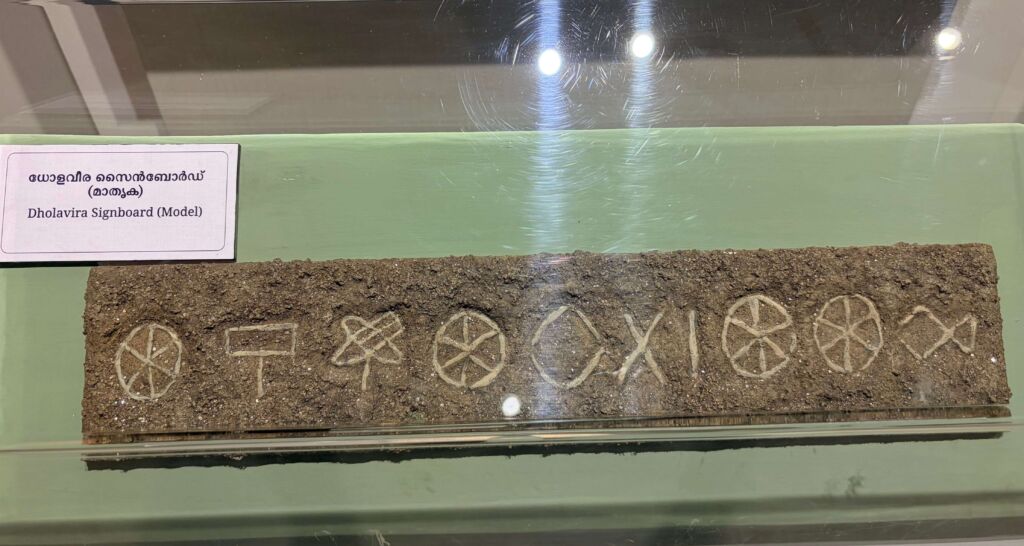
The original signboard was found at Dholavira in present-day Gujarat and stands out because of its impressive size and easily readable characters. Although the precise meaning of these symbols remains a mystery, they are thought to have been used for identification or communication. This exhibit beautifully showcases both the remarkable progress and the intriguing mystery surrounding early writing systems in ancient urban civilizations.
6. Perumbavoor Hero Stone Inscription
This panel showcases a local hero stone inscription from Perumbavoor, dedicated to the warrior Venadu Veeran. It records the site where he fought and died defending his king. Hero stones are memorials found throughout South India, usually erected to honor those who died in battle or in heroic acts.
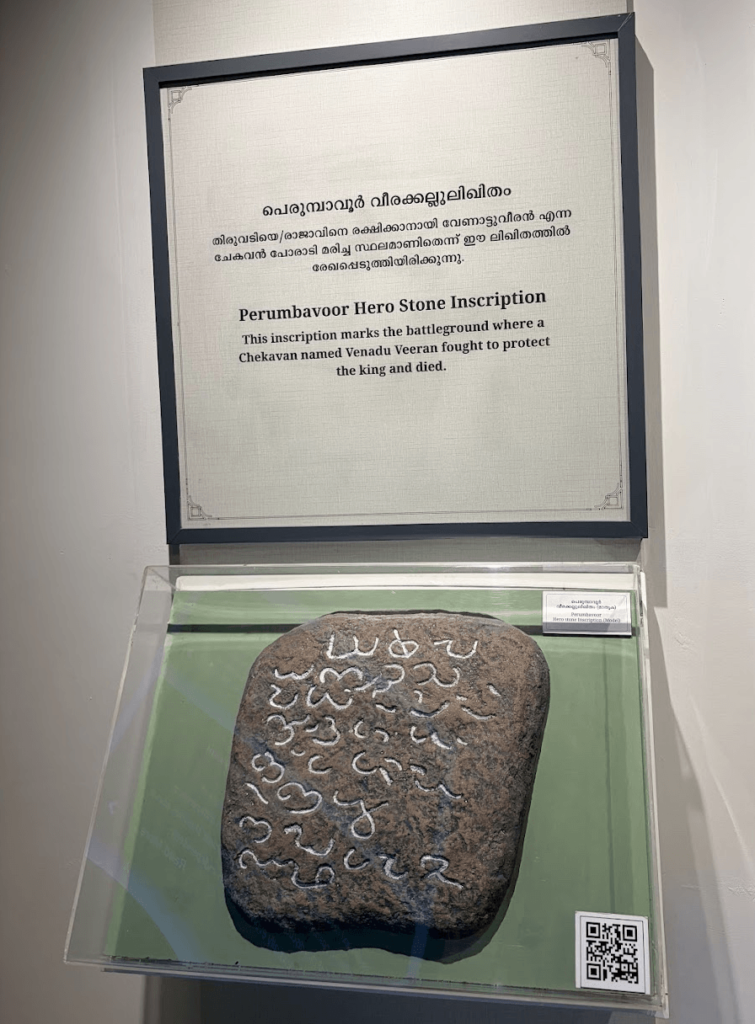
These inscriptions often feature concise narratives or symbolic carvings that record events. This exhibit links regional history to the broader theme of writing, illustrating how inscriptions served not only administrative purposes but also remembrance and storytelling.
7. Brahmi Script Display (3rd Century BCE)
This digital display beautifully showcases the Brahmi script, one of the earliest writing systems from the Indian subcontinent. Brahmi script is attested from at least the 3rd century BCE and became foundational to many later Indian scripts. It was commonly used in inscriptions, such as those of Emperor Ashoka, highlighting its historical significance.
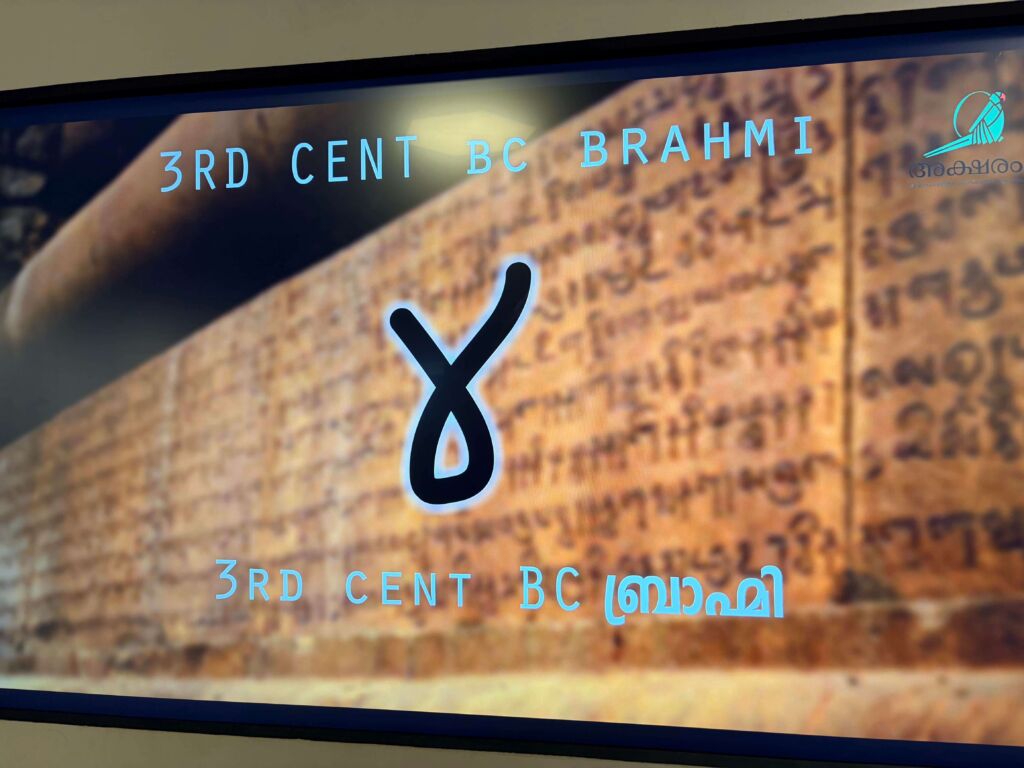
The display emphasizes its historical importance in the evolution of written communication in India. By visually showcasing the script and the visual transition of characters over centuries, the exhibit helps visitors recognize its structure and understand how it contributed to the shift from symbolic forms to more standardized, phonetic writing systems.
Watching a single letter evolve from a rough carving into a smooth, flowing script was humbling for someone accustomed to quick smartphone typing.
8. Hortus Malabaricus Display
This exhibit features Hortus Malabaricus, a 12-volume, 17th-century botanical work documenting the plant wealth of Malabar, compiled under Hendrik van Rheede with contributions from local physicians and scholars. Compiled under Dutch administrator Hendrik van Rheede, it is written in Latin and incorporates local knowledge. It is the first-ever printed book in Malayalam. The book contains plant names in Malayalam, Arabic, and Devanagari.
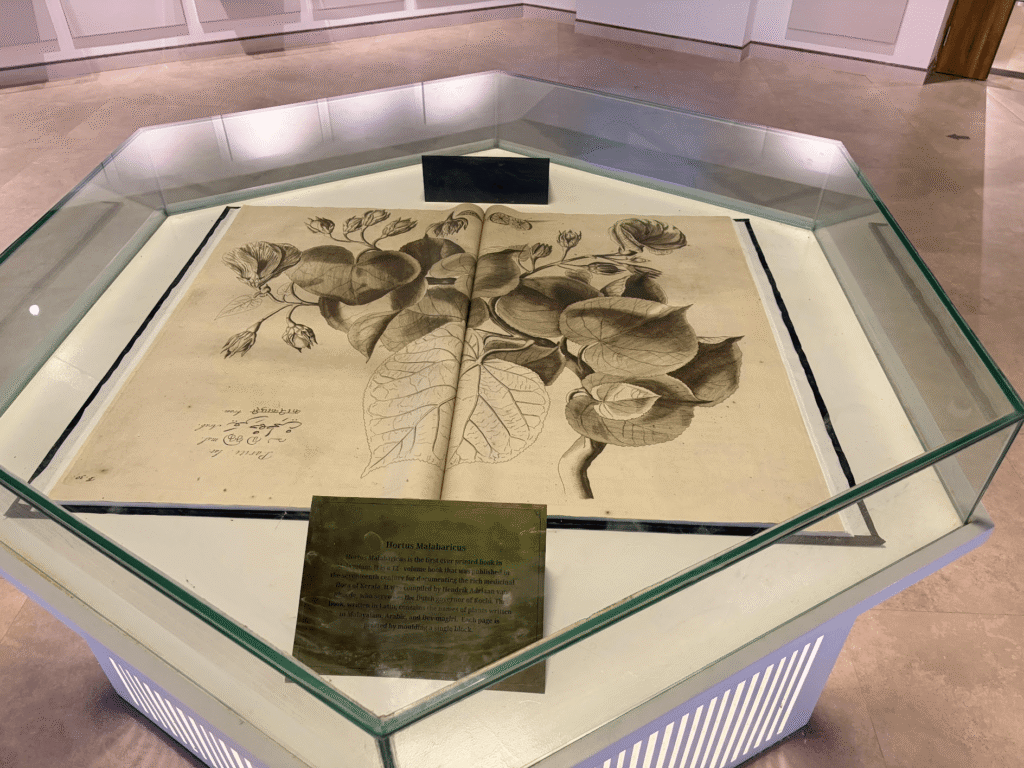
The detailed illustrations reflect early scientific documentation and the role of written records in preserving indigenous botanical knowledge.
Also Read: Kerala Home Garden article
9. Symbolic Art Installation
This beautiful illuminated installation features layered cut-out symbols depicting human activities, animals, and daily life. It offers a captivating glimpse into how early humans used symbols and imagery to share ideas long before formal writing systems existed.
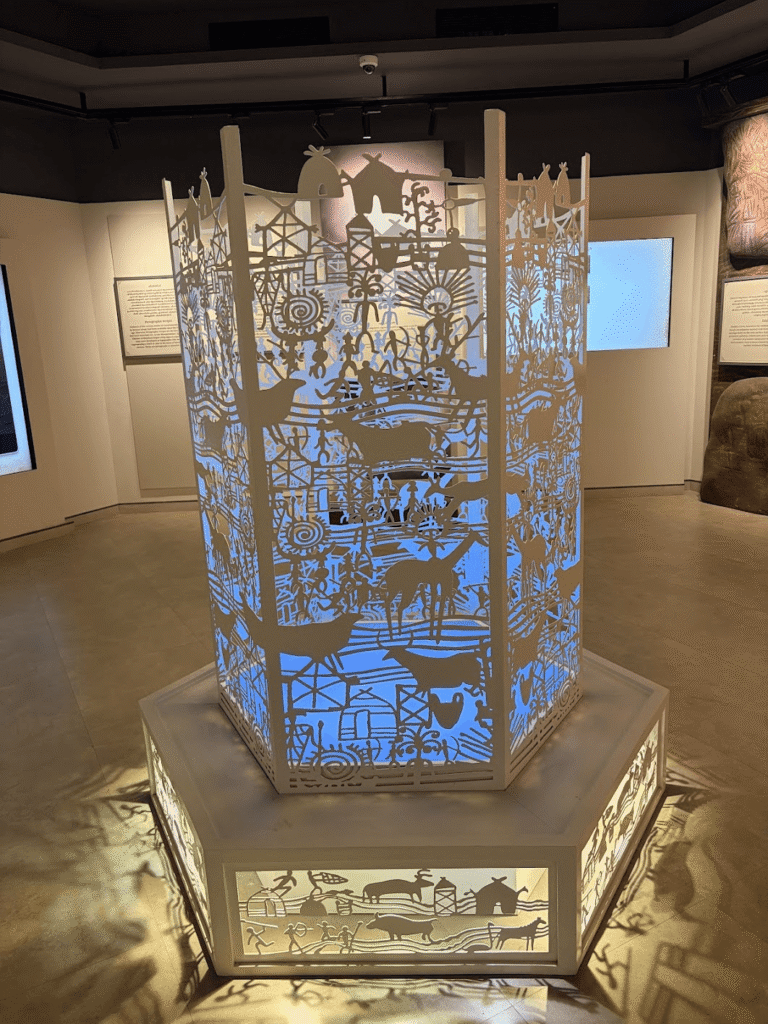
The exhibit warmly connects visual representations to the evolving story of structured scripts and visual storytelling, highlighting the rich tapestry of human communication history.
Also Read: Tranquility in the Lap of Nature – Taj Bekal Resort & Spa, Kerala
Frequently Asked Questions About the Aksharam Museum Kottayam
1. What Makes Aksharam Museum Unique?
Aksharam Museum is unlike any other for several reasons. It highlights the importance of language, something that we use daily but take for granted. Its exhibits take you through an enchanting journey that starts with primitive communication, such as symbols and cave paintings, then traces the evolution of scripts like Brahmi and Vattezhuthu, followed by the growth of Malayalam literature, and ends with the move from handwritten texts to printing. The museum uses digital panels, audiovisuals, and immersive experiences to make this journey engaging and accessible for all.
2. What is Special About the Aksharam Museum’s Building Architecture?
While most cultural spaces in Kerala feature traditional architecture, Aksharam Museum stands out for its modern, concept-driven design. It shows how language has continued to evolve through the centuries.
3. Who should visit the Aksharam Museum, Kottayam?
Aksharam Museum is ideal for:
- Writers, bloggers, and content creators
- Students and educators
- Anyone curious about language, culture, and storytelling
- Travelers looking for offbeat places in Kottayam
4. What are the Timings, Fee, and Location of the Aksharam Museum Kottayam?
- Location: Nattakom, about 5–6 km from Kottayam town
- Timings: Around 10 AM to 7 PM (Closed on Mondays)
- Entry Fee: Approx. ₹60 for adults, ₹30 for children
- Approximate visit time: 1-1.5 hours
- Photography: Allowed in most sections (do confirm onsite)
- Parking: Available
Please note: Museum exhibits and policies may change over time. Please verify timings and entry details before visiting.
5. What Makes the Aksharam Museum’s Exhibits Engaging?
A lot of people think that museums are boring, but not the Aksharam Museum. It is modern, engrossing, and interactive, giving you the chance not just to watch but to engage with the exhibits.
The museum uses screens and sounds to make the history feel alive. You can touch, listen, and watch. You can see the transition from palm-leaf manuscripts (written by hand with a sharp metal stylus) to the very first printing presses brought to Kottayam.
-
The Evolution of Alphabets: How simple scratches on stone evolved into the complex letters we use today.
-
The History of Language: How different tongues developed around the world, particularly in Kerala.
-
Modes of Communication: How we progressed from cave paintings and smoke signals to printing presses and digital screens.
Why You Should Visit Aksharam Museum Kottayam
The Aksharam Museum doesn’t seem like a boring, one-dimensional space that features old items. Rather, it feels vibrant, modern, and designed to enthrall. Here’s why I enjoyed visiting the museum.
-
The Interactive Feel: You can touch, listen, and watch. It’s perfect for kids and adults alike.
-
The Design: The building itself is a work of art. Every corner is “photo-worthy” and feels fresh and inviting.
-
The Story: It explains that language is about how we express our feelings and our history.
Also….
- Unique concept in India
- Carefully curated exhibits
- Suitable for both children and adults
- Perfect for contemplative travelers
- Visually striking displays
Also Read: The Leela Kovalam Review – India’s Only Cliff-Side Luxury Hotel
Final Thoughts
I walked into the Aksharam Museum Kottayam because a “beautiful building” caught my eye, but I walked out with a whole new appreciation for how the ‘word’ came about. It’s rare to find a place that makes the history of grammar and phonetics feel like a high-tech adventure and takes you back to a time when communication happened in an entirely different way.
Whether you live in Kottayam or are just passing through, as I was, make sure to stop by. The Aksharam is a modern, world-class tribute to how we speak, write, and connect with one another. It reminds us that no matter our language or communication style, it’s the intention and the story that bind us and keep us together.
About the Reviewer: Akanksha is a Kerala-based writer and experiential reviewer documenting destinations through honest, first-hand visits. Her work focuses on how places make people feel through design, culture, atmosphere, and the details that often go unnoticed. From tourist attractions and museums to retail spaces, hotels, resorts, and restaurants, she creates thoughtful reviews that go beyond ratings, helping readers discover experiences worth remembering.
Spotted an error? Let me know, and I will be happy to correct it.
Liked my take on the Aksharam Museum? Share your feedback.
If you run a museum, hotel, retreat, restaurant, wellness space, or cultural destination and need thoughtful review writing or experience-led storytelling, I’d love to help. As The Dependable Writer, I create warm, engaging experiential reviews and feature pieces. To collaborate or hire me for reviews and storytelling content, feel free to reach out.